News

Orange and Telekom back European space partnerships

Eutelsat and Orange have reinforced their partnership with new multi-year low Earth orbit (LEO) agreement, leveraging Eutelsat’s OneWeb constellation. The deal follows a similar deal March, where Orange and Canada’s Telesat signed a multi-year partnership for Telesat Lightspeed LEO satellite connectivity and terrestrial infrastructure. Both announcements form a not-too-subtle message that Europe’s largest operators are not going to sit around and rely on US constellations, Starlink and Kuiper.

Five highlights from EU Space Days 2025

EU Space Days 2025 brought the European space community to Gdańsk for two packed days of discussion and inspiration. Organised by the European Commission under the auspices of the Polish Presidency of the Council of the EU, and held alongside InfoShare, the region’s largest startup and tech conference, the event featured a rich mix of sessions, the most ambitious EU Space Days exhibition to date.

Europe’s far-reaching Space Act nears launch

Europe is expected to publish a draft law by the end of June to overhaul the regulation of space services, introducing unified rules for companies operating in or selling to the European market.

MoonRad Industry Day Reveals Ambitious Plans for Lunar Exploration

With the aim of expanding its role in space research, Hungary hosted MoonRad Industry Day on Monday. The event, organized by the HUN-REN Hungarian Research Network, the Ministry for National Economy, and the European Space Agency (ESA), served to present the MoonRad Lunar Exploration Space Weather Monitoring SmallSat Mission and establish a potential international industrial consortium.

ROK-U.S. New Space Seminar Held to Promote Civil Space Cooperation

The Korea AeroSpace Administration (KASA), led by Administrator Yoon Youngbin, and the Ministry of Foreign Affairs (MOFA), led by Minister Cho Tae-yul, co-hosted the ROK-U.S. New Space Seminar on Tuesday, April 15, 2025 (local time), in Washington, D.C., United States. The seminar was held on the occasion of the 4th ROK-U.S. Civil Space Dialogue, aimed at facilitating exchanges between Korean and U.S. space companies.


The Challenge Call for DIANA’s 2026 Cohort is live

DIANA is the Defence Innovation Accelerator for the North Atlantic, an organisation established by NATO to find and accelerate dual-use innovation capacity across the Alliance.

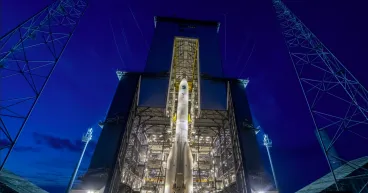
How Project Kuiper is contributing to the European space industry

Amazon's satellite internet network, Project Kuiper, aims to bridge the global digital divide by providing fast, reliable broadband to customers and communities around the world. The system is built around a constellation of more than 3,000 satellites in low Earth orbit, and Amazon has tapped hundreds of businesses across the European Union (EU)—including major partners like Arianespace and Beyond Gravity—to deliver on its mission.

New Venus observation mission - World's first long-term planetary cubesat study by Korea's Institute for Basic Science and NanoAvionics

Kongsberg NanoAvionics (NanoAvionics), a leading small satellite bus manufacturer and mission integrator, has been selected by the Institute for Basic Science (IBS) in South Korea to build the first CubeSat for the world's first long-term planetary science campaign which will use a series of CubeSats to monitor Venus from low Earth orbit.

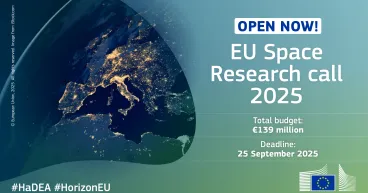
Horizon Europe – EU Space Research Call 2025 open for submission

The Horizon Europe EU Space Research Call 2025 (HORIZON-CL4-2025-02, SPACE-HADEA) is now open for submissions. With a total budget of €139 million, this call under Cluster 4—Destination 5 (Digital, Industry and Space) funds collaborative projects that advance Europe’s leadership in space research, technology and applications.

T-Minus to Launch a Pair of Barracuda Rockets from Nova Scotia

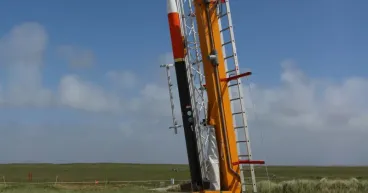
Dutch rocket builder T-Minus Engineering has signed an agreement with Canada’s Maritime Launch Services to carry out two rocket launches from Spaceport Nova Scotia in October.

Axiom Mission 4 Targets Launch No Earlier than Tuesday, June 10

NASA, Axiom Space, and SpaceX are targeting no earlier than 8:22 a.m. EDT on Tuesday, June 10, for launch of the fourth private astronaut mission to the International Space Station, Axiom Mission 4. This shift allows teams to account for predicted inclement weather during the SpaceX Falcon 9 rocket and Dragon spacecraft transport in addition to completing final processing of the spacecraft ahead of launch.

ESA supports Moon mission carrying first European rover

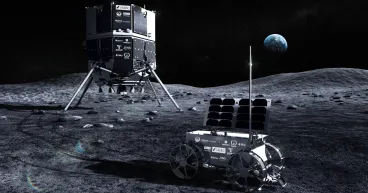
Japanese lunar exploration company ispace will attempt to land its RESILIENCE spacecraft on the Moon no earlier than 5 June (CEST) 2025. The European Space Agency’s (ESA) global network of ground stations is facilitating communication between the spacecraft and ispace mission control.