News

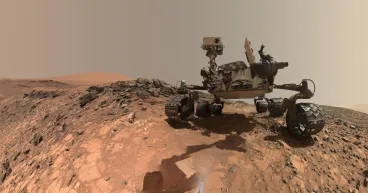
Curiosity Mars rover discovers largest organic molecules ever seen on Red Planet

While the presence of these molecules is not proof of ancient life on Mars, scientists say it shows we could detect chemical signatures of past life, if it ever existed.

ESA issues call for proposals for European Launcher Challenge

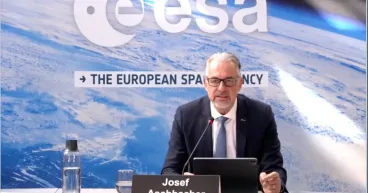
The European Space Agency has officially kicked off a competition to support new launch vehicles, but the winners, if any, won’t be known for at least eight months. ESA formally published a call for proposals, known by the agency as an invitation to tender (ITT), for the European Launcher Challenge March 24. Proposals are due on May 5, with up to 169 million euros ($183 million) available to each selected vehicle.
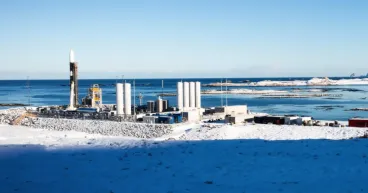
1st-ever orbital rocket launch from European soil targeted for March 24

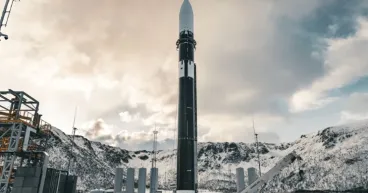
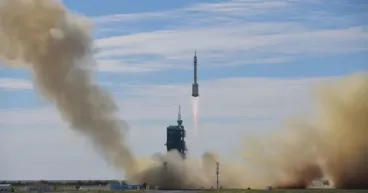
Germany-based Isar Aerospace is targeting no earlier than Monday, March 24, for the maiden voyage of its brand new Spectrum rocket. As Spectrum's first test flight, Isar has opted not to fly any customer payloads onboard the rocket, and instead is focusing on collecting as much data from the flight as possible. This will also be the first launch from Europe's Andøya Spaceport, which opened in 2023.

Pangea Aerospace raises Series A round to fund space propulsion work

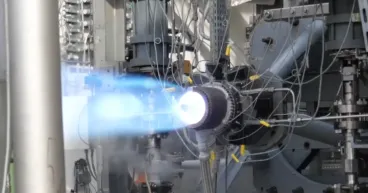
Spanish propulsion startup Pangea Aerospace has raised 23 million euros ($25 million) to further development of advanced rocket engines for use in launch vehicles and spacecraft. The funds will allow Pangea, based in Barcelona and with offices in Toulouse, France, to accelerate its growth in the European market for propulsion systems, seeking both institutional and private customers.

The European Union’s push for next generation space electronics and critical technologies

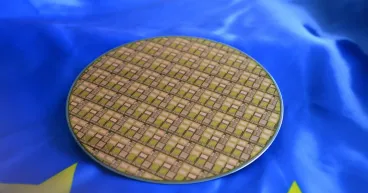
The European Commission has started investing in space research in order to strengthen Europe’s capabilities in critical technologies. One of the key framework programmes to support this mission is the Horizon Europe 2021-2027, where EU Space Research and Innovation (R&I) Work Programme has a dedicated topic covering Critical Space Technologies aimed at building stronger, resilient EU-based space capabilities.

Space Industries sets ambitious goals for satellite assembly, integration and testing

Giuseppe Santangelo returned to Turin, Italy to establish Space Industries, a business focused on rapid assembly, integration and testing of satellites as large as eight cubic meters. By 2030, Space Industries will employ 300 people and produce one satellite per workday.

ESA releases strategy document that emphasizes autonomy

The European Space Agency has released a strategy for its next 15 years that includes a greater emphasis on autonomy amid broader geopolitical changes. The strategy includes five goals: protect our planet and climate, explore and discover, strengthen European autonomy and resilience, boost European growth and competitiveness, and inspire Europe.

Chinese company targets crewed orbital spaceflight

A Chinese space company is setting its sights on crewed orbital spaceflight, marking a new step in the expansion of China’s commercial space sector. Zhang Xiaomin, chairman of AZSpace, told the Chinese outlet Securities Daily last week that, “we plan to officially conduct orbital manned flight tests in 2027 or 2028.”

Space HPC: The new ESA supercomputer is born

The European Space Agency, in partnership with Hewlett Packard Enterprise (HPE), has inaugurated its state-of-the-art high-performance computing (Space HPC) environment at ESRIN, Italy. The opening, on Wednesday 12 March, marks an important milestone in ESA’s mission to push the boundaries of innovation for European space activities.

Private Starlab space station moves into 'full-scale development' ahead of 2028 launch

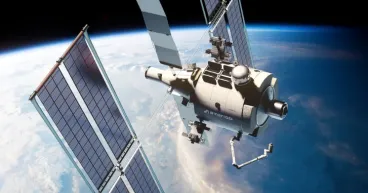
The Starlab commercial space station project is moving toward the production phase, having passed a key development milestone with NASA. Starlab, a joint project between the U.S. space technology firm Voyager Space and European aerospace conglomerate Airbus, will consist of a service module and a habitat large enough to host four space tourists. Currently, the station is expected to launch in 2028 aboard SpaceX's Starship megarocket.

Europe funds inflatable satellite drag sail demonstration

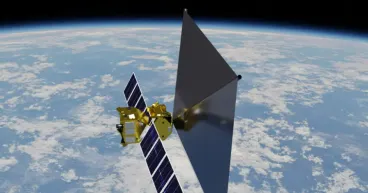
A group of European companies has secured government funds to test an inflatable drag sail in space by 2028, designed to swiftly deorbit its host satellite after mission completion. Two-year-old Portuguese startup Spaceo is leading the consortium, which announced a 3 million euro ($3.3 million) contract from the European Space Agency March 18 for the demonstration in low Earth orbit.

Brussels mulling new military intel satellites

The European Commission is considering expanding its satellite capacities to improve geospatial intelligence support for security,” EU defense chief tells the FT.